Key takeaways
-
Generative engine optimization (GEO) gets your business named in AI answers. It covers ChatGPT, Google's AI Overviews and AI Mode, Gemini, Perplexity and Microsoft Copilot.
-
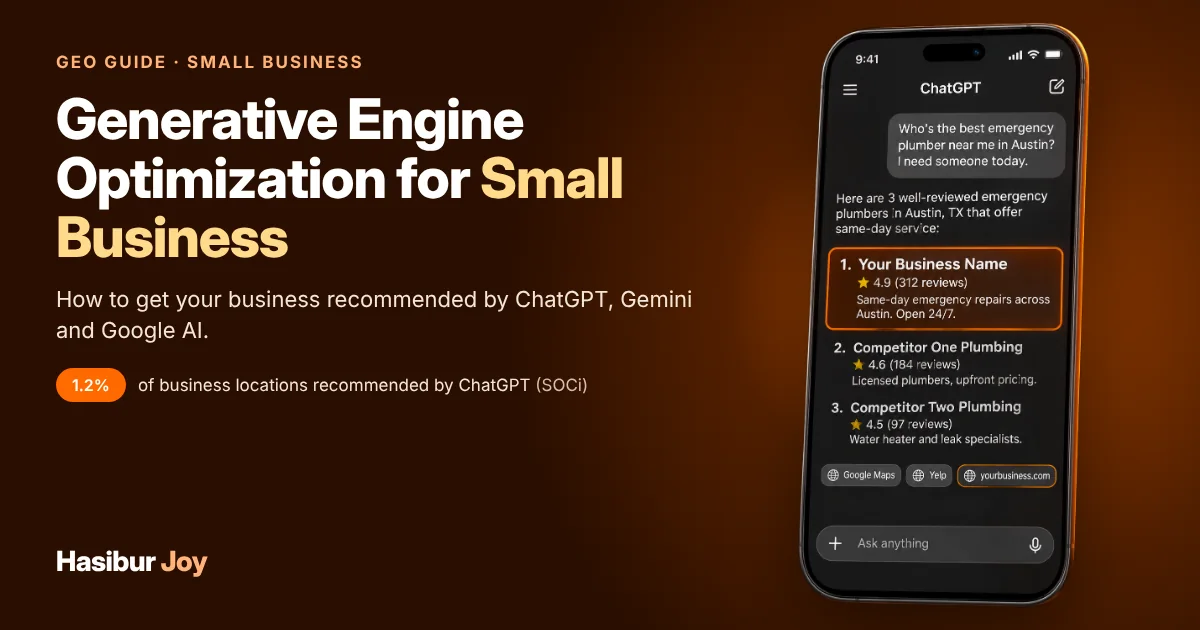
AI tools recommend very few local businesses. SOCi's 2026 study found ChatGPT recommended 1.2% of business locations, while Google's local 3-pack showed 35.9%.
-
GEO builds on SEO, it doesn't replace it. Google says AI Overviews need no special optimization beyond normal SEO best practice.
-
Five things decide AI visibility: crawler access, accurate business facts, quotable answers, third-party proof and regular measurement.
Generative engine optimization for small business gets your business found, trusted and named. It's the work that matters when customers ask AI tools for a recommendation.
This guide shows how AI tools choose local businesses and what the latest research says. It also explains the 5-step method Hasibur Joy uses with small business clients in the US and UK.
What Is Generative Engine Optimization for Small Business?
Generative engine optimization (GEO) is the process of making your business easy for AI tools to find, understand and recommend. The goal is simple: when someone asks ChatGPT for "the best plumber in Leeds," your business is in the answer.
GEO is also called AI search optimization, answer engine optimization (AEO) or LLM optimization. The names differ, but the job is the same.
AI answers draw on 2 places:
- Your own website: service pages, FAQs, prices, service areas and contact details.
- The wider web: your Google Business Profile, directories, reviews, local news and forum mentions.
A small business needs both. A strong website with no reviews looks untested. Great reviews with a thin website give AI tools nothing to quote.
Why Does AI Search Matter for Small Businesses Now?
AI search matters because customers now ask AI tools which local business to choose, and those tools name only a few. Small businesses that don't appear in the answer aren't in the running.
The shift happened fast. BrightLocal's 2026 Local Consumer Review Survey found 45% of consumers used AI tools for local business recommendations, up from 6% a year earlier.
AI tools are also far pickier than Google Maps. SOCi's 2026 Local Visibility Index studied more than 350,000 locations and found these recommendation rates:
| Platform | Share of locations shown or recommended |
|---|---|
| Google local 3-pack | 35.9% |
| Gemini | 11% |
| Perplexity | 7.4% |
| ChatGPT | 1.2% |
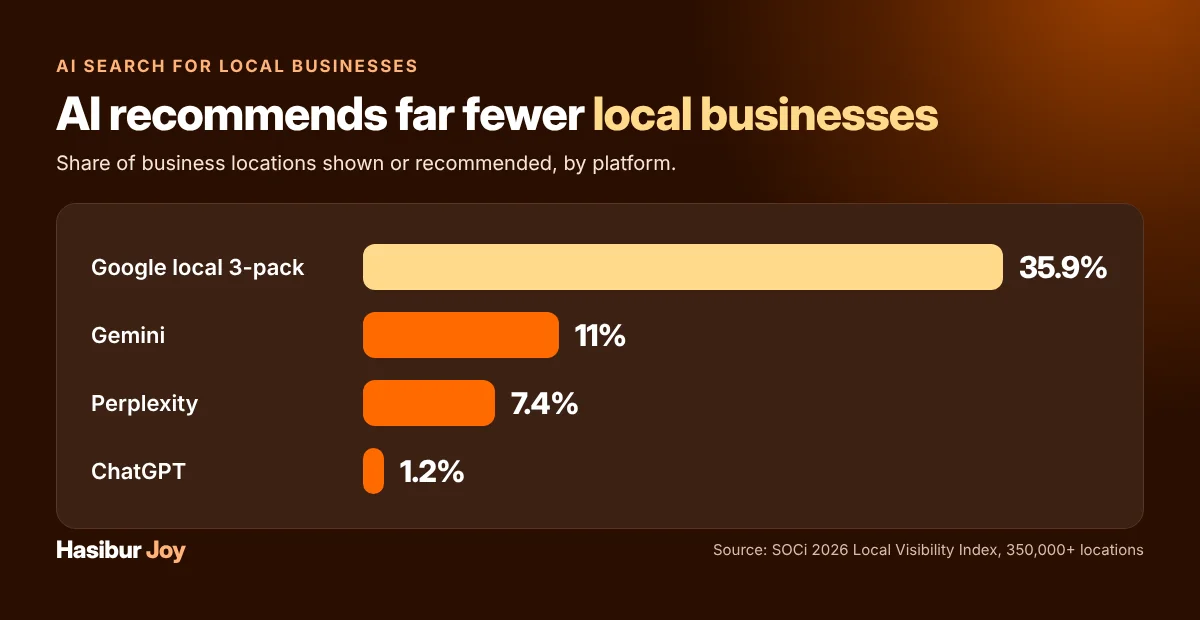
SOCi studied brands with 50 or more locations, so independent businesses face their own mix of competitors. The pattern still holds: AI tools name a handful of businesses, not a page of ten.
Clicks are changing too. Pew Research Center found Google users clicked a regular result in 8% of visits with an AI summary. Without one, they clicked in 15% of visits.
Google still counts. In a BrightLocal survey reported by EMARKETER, 75% of people who used AI to find a local business checked Google or Maps first. Only then did they get in touch. GEO adds a channel. It doesn't remove one.
How Is GEO Different From SEO?
SEO earns a ranking in a list of links, and GEO earns a mention inside an AI answer. Both rely on the same foundation, so a small business doesn't choose one over the other.
| SEO | GEO | |
|---|---|---|
| Goal | Rank your pages in search results | Get named or cited in AI answers |
| Where it shows | Google and Bing results, Google Maps | ChatGPT, Gemini, Perplexity, Copilot, AI Overviews |
| What wins | Relevant pages, links, local signals | Clear facts, quotable answers, mentions across the web |
| What you measure | Rankings, clicks, calls | AI mentions, citations, AI referral visits |
| Starting point | A crawlable, useful website | The same website, plus a consistent web footprint |
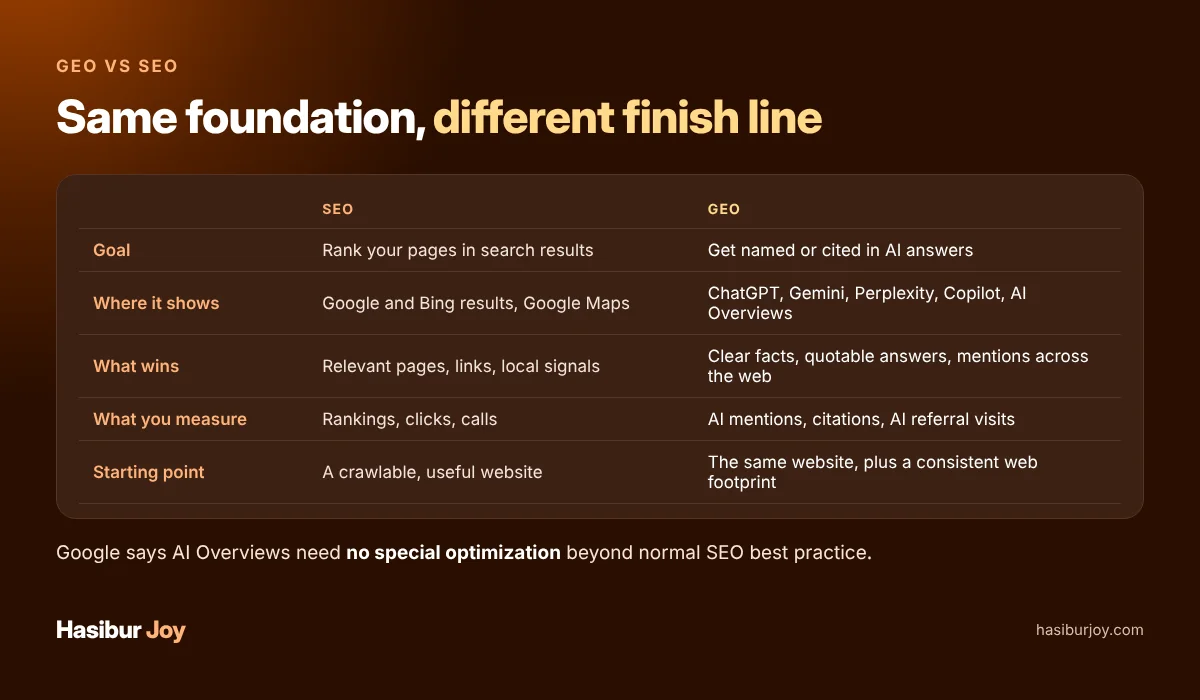
Google's guidance on AI features says there are no extra requirements and no special optimizations for AI Overviews or AI Mode. Normal SEO best practice applies. If you're new to the basics, start with what SEO is and how it works for small businesses.
Rankings alone aren't enough, though. Ahrefs found that 76% of AI Overview citations ranked in the top 10 in July 2025. Its March 2026 update found just 38%. Ahrefs links the drop to Google splitting a question into related sub-questions and citing pages that answer those.
Mentions matter more than links. An Ahrefs study of 75,000 brands found brand web mentions correlated with AI Overview visibility at 0.664, while backlinks correlated at 0.218. Correlation isn't proof of cause, but the gap is wide.
How Do AI Tools Choose Which Local Business to Recommend?
AI tools recommend the local businesses they can verify most easily: accurate facts, strong reviews and repeated mentions on trusted sites. A business that's hard to confirm gets left out.
Three findings show how this plays out:
- Each AI tool reads different data. SOCi found business details were 100% accurate on Gemini, which draws on Google Maps. ChatGPT and Perplexity were only about 68% accurate.
- Reviews act as a filter. Locations that ChatGPT recommended averaged 4.3 stars in the SOCi study.
- Customers check the AI's homework. BrightLocal reported that 88% of consumers fact-check reviews cited by AI tools.
The 68% figure matters most. If ChatGPT gets your hours, prices or service area wrong, the fix sits in the sources it reads, not in ChatGPT itself.
The 5 A's: A Generative Engine Optimization Framework for Small Businesses
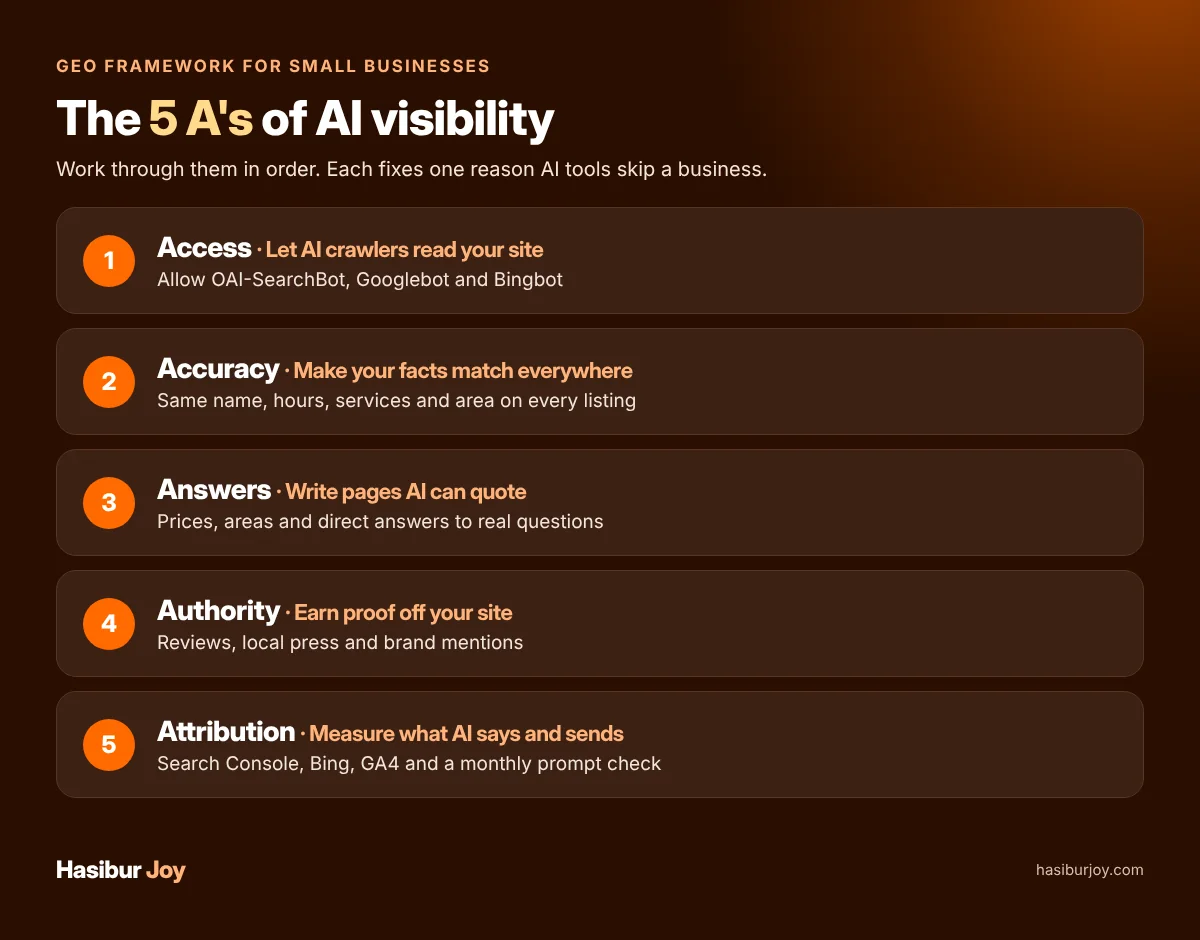
Hasibur Joy uses a 5-step framework for small business GEO: Access, Accuracy, Answers, Authority and Attribution. Each step fixes one reason AI tools skip a business, and the steps run in that order.
1. Access: Let AI Crawlers Read Your Site
AI tools can't recommend what they can't read. The first step is checking that your robots.txt file, CDN and hosting don't block the crawlers that feed AI search.
OpenAI runs separate crawlers, and they do different jobs. OpenAI's crawler documentation explains them:
- OAI-SearchBot: Surfaces websites in ChatGPT search. Sites that block it don't appear in ChatGPT search answers.
- GPTBot: Collects content for training OpenAI's models. Blocking it opts you out of training, not out of search.
- ChatGPT-User: Visits a page when a ChatGPT user asks about it.
Hasibur Joy found this problem on his own site during a migration. Cloudflare's AI crawler settings were blocking GPTBot and ClaudeBot through robots.txt, and switching those settings to "Allow" fixed it. Check your own settings the same way.
Don't stop at Google. Microsoft tracks Copilot citations in Bing Webmaster Tools, so submit your sitemap there too.
2. Accuracy: Make Your Business Facts Match Everywhere
AI tools trust a business more when every source tells the same story. Your name, address, phone number, hours, services and service area match across your website and every listing.
Start with the 5 listings that feed most local answers:
- Google Business Profile: The main source for Google Maps, and Gemini draws on Maps data.
- Bing Places for Business: Microsoft recommends it to keep your address, hours and contact details current.
- Apple Business Connect: Controls how you appear in Apple Maps and Siri.
- Yelp: A major review source in the US.
- Your industry directory: Such as Checkatrade, Houzz or Avvo, depending on your trade.
Match the wording exactly. "Smith & Sons Plumbing" on Google and "Smith and Sons Plumbing Ltd" on Yelp look like two businesses to a machine.
3. Answers: Write Pages AI Can Quote
AI tools quote pages that answer a question directly and specifically. Vague copy like "quality service at fair prices" gives them nothing to use.
Write each key page so a single paragraph answers a real customer question:
- Lead with the answer: For example, "Boiler servicing in Bristol costs £80 to £120 and takes about an hour."
- Name the specifics: Prices, service areas, hours, response times, brands you work with and qualifications.
- Answer the follow-ups: Add an FAQ for the next 5 questions customers ask on the phone.
- Keep schema honest: Google says structured data matches the visible text on the page.
Think about the fan-out questions too. Someone asking for "a good dentist in Austin" also wants to know about insurance, emergency hours and parking. A page that covers those gets more chances to be cited.
4. Authority: Earn Reviews and Mentions Off Your Site
Off-site proof tells AI tools that real people use and talk about your business. Reviews, local press and mentions on trusted sites do that job.
Focus on 3 sources of proof:
- Reviews on several platforms: Ask every happy customer, and reply to every review. BrightLocal's data shows people check the reviews AI tools quote.
- Local mentions: Chamber of commerce pages, local news stories, sponsorships and supplier "where to buy" lists.
- Community answers: Helpful, honest replies in local Facebook groups and Reddit threads, without spam.
A mention doesn't need a link to count. The Ahrefs data above shows plain brand mentions tracked AI visibility far more closely than backlinks did.
Video helps too. In Ahrefs' citation study, 18.2% of AI Overview citations that didn't rank in Google's top 100 were YouTube videos. A short video answering a common customer question gives AI tools one more source to cite.
5. Attribution: Measure What AI Says and Sends
GEO needs its own scorecard, because normal rankings don't show AI mentions. Four free sources cover most of it:
- Google Search Console generative AI report: Google's new report shows how often your pages appeared in AI Overviews and AI Mode. You can split it by page, country and device, but it doesn't show clicks or queries.
- Bing Webmaster Tools AI Performance: Shows citations in Microsoft Copilot and Bing AI summaries, plus the grounding queries behind them. It doesn't cover ChatGPT.
- Google Analytics 4 referrals: Look for visits from chatgpt.com, perplexity.ai and gemini.google.com. ChatGPT citation links usually carry
utm_source=chatgpt.com, according to SearchPilot's AI traffic reference. - A monthly prompt check: Ask each AI tool the same customer questions every month and log the answers.
Track trends, not single answers. AI tools give slightly different answers each time, so one bad result isn't a crisis.
How Do You Get Your Small Business Cited in ChatGPT?
You get cited in ChatGPT by letting OpenAI's search crawler in, keeping your facts consistent and earning proof on trusted sites. No form or fee puts you in ChatGPT's answers.
Work through these 6 steps:
- Allow OAI-SearchBot: Check robots.txt and your CDN settings. Blocking it removes you from ChatGPT search answers.
- Get indexed: Make sure your key pages are indexed in Google and Bing.
- Fix your facts: Correct your name, hours, services and area on every listing.
- Publish quotable pages: Answer real questions with prices, areas and specifics.
- Build reviews: ChatGPT's recommended local businesses averaged 4.3 stars in SOCi's study.
- Test monthly: Ask ChatGPT "who's the best [service] in [town]" in a new chat and log the result.
Treat any offer of "guaranteed ChatGPT placement" as a red flag. No outside company controls which businesses ChatGPT names.
How Do You Check What AI Says About Your Business?
You check what AI says about your business by asking each AI tool the same customer questions every month. Then you log the answers. The check needs no paid software.
Hasibur Joy's monthly AI check uses 10 prompts across 4 tools:
- Write 10 prompts: Use customer wording, such as "best emergency electrician in Leeds" or "who installs EV chargers near Bristol."
- Run them in 4 tools: ChatGPT, Gemini, Perplexity and Google AI Mode, each in a new chat.
- Log 4 things: Whether you're named, your position in the answer, which competitors appear and which sources are cited.
- Fix the sources: If an answer gets your facts wrong, correct the listing or page it cites.
- Compare month to month: Count how many of the 40 answers name your business.
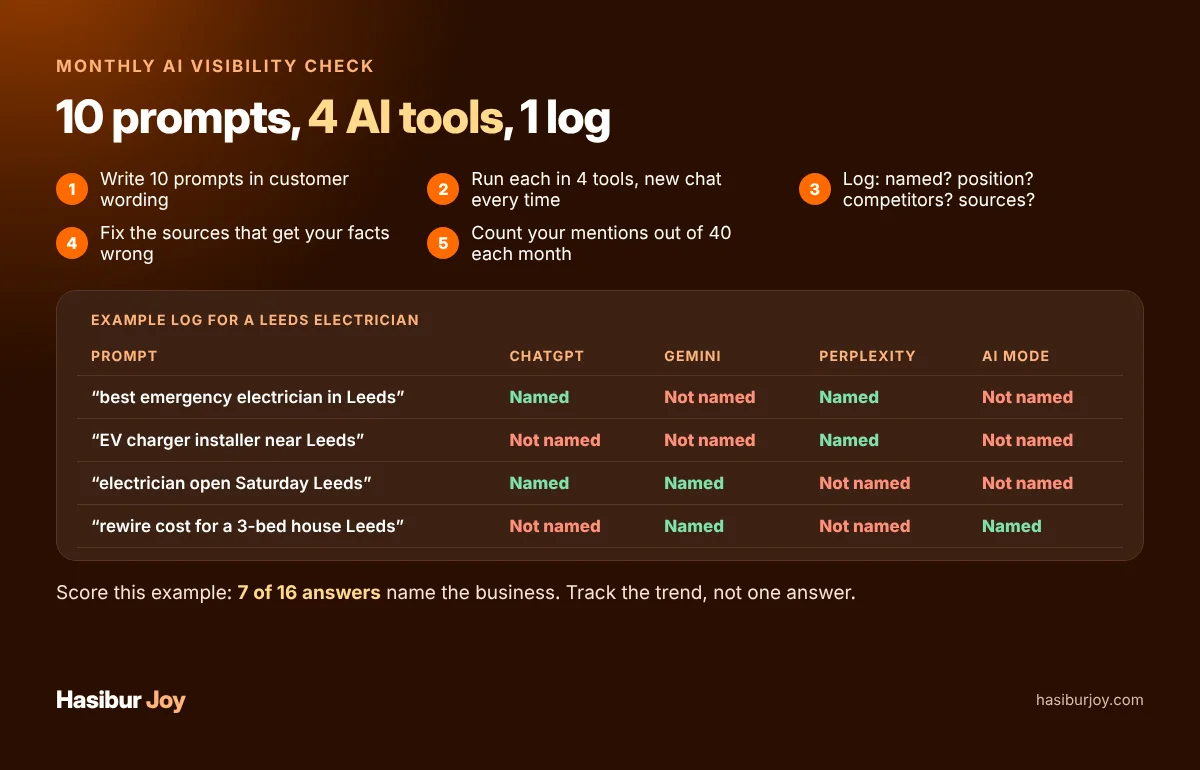
The cited sources are the most useful part. If Perplexity keeps citing a directory you're missing from, that directory goes to the top of your list.
What Does Hasibur Joy's Client Work Show?
Hasibur Joy's client work shows that the structure built for Google rankings also builds AI visibility. Teambuild Consultancy, a UK staffing firm, is the clearest example.
Teambuild's pages earned 19,800 views in Google's AI features, and 13,798 of those came from the UK. That's 70% from the one country Teambuild sells to.
None of it came from AI tricks. The work was a topical map, one industry at a time, UK citations and press mentions. Those are the same Accuracy, Answers and Authority steps in the 5 A's.
A local business repeats the method on a smaller scale. Pick one service, answer every question customers ask about it, and earn reviews and local mentions for it. Then move to the next service.
What GEO Mistakes Should Small Businesses Avoid?
Six GEO mistakes waste the most time and money for small businesses:
- Blocking the wrong crawler: Blocking GPTBot to stop training is fine. Blocking OAI-SearchBot removes you from ChatGPT search.
- Expecting a special file to fix it: Google says AI Overviews need no AI-specific files or markup. Treat extras like llms.txt as optional, not as a fix.
- Paying for guaranteed mentions: Nobody outside the AI companies controls their answers.
- Writing vague copy: "Trusted local experts" can't be quoted. A specific line, such as "same-day boiler repair across Bristol, from £90," can.
- Ignoring Bing: Bing Webmaster Tools is the only free source of Copilot citation data, and many small businesses never set it up.
- Letting facts go stale: Old hours or a past address on one directory spread into AI answers.
Frequently Asked Questions
Is generative engine optimization worth it for a small business?
Yes, for most local businesses. 45% of consumers now use AI tools to find local businesses, according to BrightLocal. Most GEO work also improves Google rankings, so little of the effort is wasted.
How long does GEO take to work?
GEO builds over months, not days. A fixed crawler block or corrected listing counts once your pages are recrawled. Google says that takes from several days to several months. Reviews and mentions build more slowly.
Is GEO the same as AEO?
Yes, mostly. Answer engine optimization (AEO) and generative engine optimization (GEO) both aim to get your business into AI answers. Some marketers use AEO for featured snippets and voice answers too.
Can I pay to appear in ChatGPT answers?
No company can sell you a guaranteed spot in ChatGPT's answers. ChatGPT names businesses based on what it finds and trusts across the web, so the work is earning that trust.
Does Google Business Profile affect AI search?
Yes. SOCi found business details on Gemini were 100% accurate because Gemini draws on Google Maps data. Google also lists keeping Business Profile information current as a best practice for its AI features.
Do I need llms.txt for AI search?
No. Google says AI Overviews and AI Mode need no special AI files or markup. An llms.txt file is optional and won't fix weak content or missing reviews.
Start With an AI Visibility Check
Generative engine optimization for small business starts with knowing what AI tools say about you today. Run the monthly check above, fix your facts and build pages worth quoting. Then earn the reviews and mentions that prove you're the right choice.
Hasibur Joy has done hands-on SEO since 2018 and has helped 35+ small businesses grow from search. He builds GEO into a full plan for SEO for small businesses, because the two share the same foundation.
Want the work done for you? See his generative engine optimization services. Or book a free consultation to talk through what AI says about your business.
Book a free consultation