
TL;DR:
-
SEO builds organic search traffic that costs nothing per click once rankings hold.
-
PPC (Google Ads) delivers results within 24 to 48 hours, but stops the moment ad spend stops.
-
At 12 months, SEO generates leads at $14 to $50 each. PPC runs $75 to $300+ per lead in the same categories.
-
Local SEO, including Google Business Profile optimization, captures local search intent at zero cost per click.
-
The strongest approach: start SEO now, use PPC to bridge the revenue gap while organic rankings build.
Small business owners deciding where to put their marketing budget face the same question every time: SEO or PPC? Search engine optimization earns organic rankings on Google Search without paying per click. Pay-per-click advertising, mainly through Google Ads, puts paid ads at the top of the search engine results page immediately. Both show up on the same page. Both drive traffic. But the cost structure, timeline, and return on investment are very different.
This comparison gives you real numbers so you can make the right call for your specific business goals.
What Is the Difference Between SEO and PPC?
SEO and PPC are the two main digital marketing channels for getting a business onto Google search results, and they work in opposite ways. Search engine optimization (SEO) helps you get free, organic search rankings. It improves three main areas: your content, technical SEO signals, and backlinks. Pay-per-click advertising lets you buy top spots on search engine results through Google Ads. Costs vary from $2 to over $50 per click, based on keyword competition.
The real difference comes down to ownership. SEO builds an organic traffic asset your business keeps. PPC rents visibility from Google Ads, and that visibility disappears when the budget runs out. That one structural difference is what drives every other comparison in this guide.
SEO vs PPC: What Does It Actually Cost?
A professional SEO retainer for a small business runs $500 to $3,000 per month. Google Ads campaigns targeting the same search traffic typically require $1,000 to $10,000+ per month in ad spend, before any management fees. At the 12-month mark, SEO-generated leads cost $14 to $50 each, while Google Ads leads in comparable categories run $75 to $300+.
According to Visionary Marketing, SEO provides an average ROI of 748%. In comparison, PPC offers a 200% ROI over the same time. The gap widens because organic search traffic grows without added cost per click, while PPC spending has to increase to maintain the same volume.
The table below shows both channels side by side across 6 budget factors.
| Factor | SEO | Google Ads (PPC) |
| Cost per month | $500 to $3,000 (service) | $1,000 to $10,000+ (ad spend) |
| Time to results | 3 to 6 months | 24 to 48 hours |
| Traffic if you stop | Stays (organic rankings) | Drops to zero instantly |
| Long-term value | Grows over time | Resets each campaign |
| Cost per lead (12+ mo.) | $14 to $50 | $75 to $300+ |
| Best fit for | Long-term growth | Immediate lead generation |
For a detailed breakdown of what SEO services cost at different budget levels, how much does SEO cost for small business covers it all.
When Should a Small Business Use SEO or PPC?
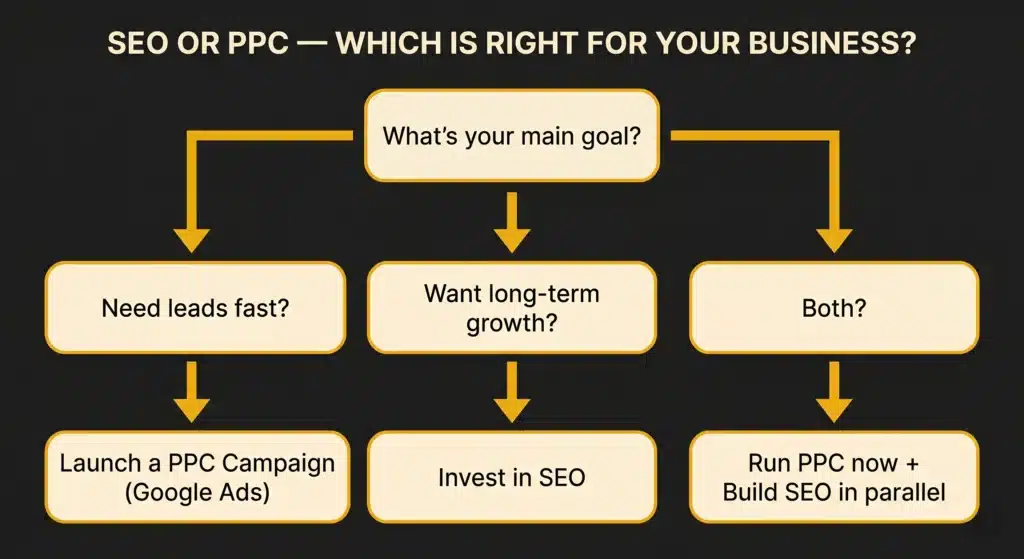
The right digital marketing channel depends on two things: how fast you need results, and how long you plan to invest. Here is a clear breakdown of when each one makes sense.
Use PPC When You Need Leads Right Now
PPC delivers targeted advertising results within 24 to 48 hours of campaign launch. That makes Google Ads the right call for new business launches, seasonal promotions, and any situation where the business needs leads before an SEO campaign reaches ranking momentum. PPC also lets small business owners test which search queries actually convert before building a full SEO content strategy around those keywords.
One practical use: run a PPC campaign to gather conversion data, then use that keyword performance data to shape your organic search strategy. PPC provides immediate insight that would take months to gather through organic search alone.
Use SEO When You Want Growth That Holds
SEO builds an organic traffic asset that keeps generating leads even when the marketing budget tightens. Organic rankings grow in strength over 12 to 36 months, lower the cost-per-lead, and build brand awareness on Google Search that paid ads cannot replicate. A business that reaches page one for its target keywords gets free clicks every day with no ongoing cost per click.
According to Sagapixel’s January 2026 data, SEO converts at 2.4% on average, nearly double PPC’s 1.3%. Organic searchers arrive with more trust and more research behind them, which is why they close at a higher rate.
Still weighing whether organic search makes sense for your category? Is SEO worth it for small business breaks it down with real numbers.
Local SEO vs Google Ads: Which One Works Better for Local Businesses?
Local SEO outperforms Google Ads for local business visibility because it captures high-intent search traffic at zero cost per click.
According to Click Vision’s March 2026 analysis, 76% of people who run a local search on their smartphone visit a nearby business within 24 hours. Local SEO captures that traffic through Google Business Profile optimization, local citation building, and location-specific content that ranks in both Google Search and Google Maps.
Google Ads places paid ads in local search results immediately, but local service businesses pay $5 to $15 per click in most categories. Local SEO builds the same presence permanently, at no per-click cost. A strong Google Business Profile, backed by consistent local citations and review signals, delivers sustained local search visibility that a PPC campaign simply cannot match on the same budget.
Should a Small Business Run SEO and PPC Together?
Running SEO and PPC together produces better return on investment than either channel alone, and the data is clear on why. The practical approach for small business owners: launch Google Ads immediately to generate leads while SEO builds organic search rankings over 3 to 6 months.
Use the PPC conversion data to identify which keywords drive the most revenue, then build SEO content around those exact terms. Reduce ad spend gradually as organic rankings take hold.
This sequence treats PPC as a short-term lead generation bridge and SEO as a long-term business growth engine. It also avoids the most common mistake small business owners make, which is running PPC as the only channel and never building the organic search asset that eventually makes marketing cheaper.
To explore pricing that makes both channels workable, check out affordable SEO packages, or see what SEO for small business includes to understand exactly what you get.
Frequently Asked Questions
Is SEO or PPC better for a small business with a limited budget?
SEO delivers better long-term return on investment for small businesses with budgets under $1,000 per month. PPC burns through limited budgets fast and stops generating traffic the moment ad spend stops. SEO builds an organic search asset that holds value long after the initial investment.
How long does SEO take to work for a small business?
SEO produces measurable ranking gains within 3 to 6 months for most small business websites targeting local or low-competition keywords. Competitive national keywords take 9 to 18 months. Google Business Profile optimization often shows local search improvements within 4 to 8 weeks.
Can a small business run Google Ads without SEO?
Yes. A small business runs Google Ads without an SEO strategy, but organic search stops generating leads the moment ad spend stops. Google Ads provides immediate paid search visibility. SEO builds the organic search traffic that sustains lead generation long-term.
What is the difference between local SEO and Google Ads for local businesses?
Local SEO builds sustained visibility in Google Search and Google Maps at zero per-click cost. Google Ads delivers immediate placement at $5 to $15 per click for most local service businesses. Local SEO optimizes the Google Business Profile, local citations, and location-specific content. Google Ads targets local search intent through paid advertising with full control over budget and geographic targeting.
The Bottom Line: Start SEO Early, Use PPC to Fill the Gap
SEO vs PPC for small business is not a binary choice. Small business owners who start SEO early build an organic search asset that reduces marketing costs year over year. PPC fills the revenue gap while organic rankings build and accelerates lead generation for launches and time-sensitive campaigns.
The right digital marketing strategy depends on your timeline and budget. A business that needs leads this week starts a PPC campaign. A business that wants lower cost-per-lead 12 months from now starts SEO today. The strongest small businesses do both: paid ads for immediate visibility, search engine optimization for long-term revenue that holds.
Ready to build the organic search foundation that reduces your Google Ads dependency over time? SEO services for small business is a good place to start.